No Food Left Behind
Jeanette Hardison — Corvallis, Oregon
It’s Saturday morning in Corvallis, Oregon, and the downtown Farmers' Market is already alive.
Tents line the street. Tables are overflowing with whatever foods happened to be ready this week. Tomatoes. Greens. Berries. Herbs. Squash. Fresh bread. People move between vendors carrying canvas bags, stopping to talk with farmers and deciding what looks good enough to take home.
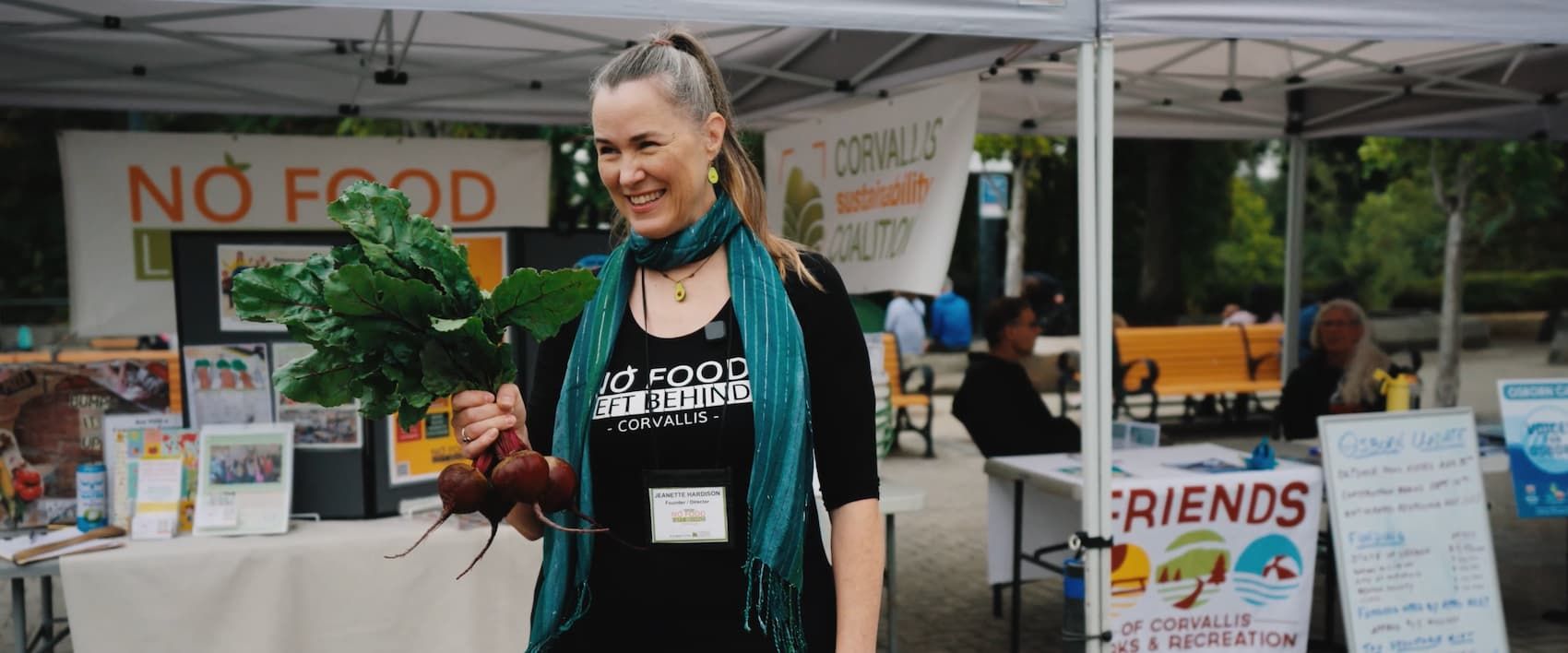
This is about as close to the beginning of our food as most of us ever get. And Jeanette Hardison and her staff have a tent right in the middle of it.
They aren't selling anything. They want to talk about what happens next.
Someone stops with vegetables they just bought. Outreach Specialist, K'Rene Kos, asks how they plan to store them until use. Someone else has a question about how long something will last. K'Rene points to a guide on the table, and a conversation begins.
For more than 30 years, Jeanette has worked in waste prevention and recycling. In 2018, she launched No Food Left Behind Corvallis, an program of the Corvallis Sustainability Coalition, focused on helping people waste less food at home.
“The average American family of 4 is spending almost $3,000 a year on food that they’ll never eat”
Spend a little time with her, though, and you realize she doesn't approach food waste like some enormous environmental problem people need to study. She makes it smaller.
What did you buy? Where are you going to put it? What should you eat first? And will you remember it's there? Those questions sound almost too simple. That's kind of the point. Because most food isn't wasted in some dramatic moment. It happens quietly.
A head of lettuce gets pushed behind something else in the refrigerator. Berries start to turn before anyone gets to them. Leftovers disappear behind the milk. We buy something for a recipe we never make. Something gets put into the freezer with every intention of being used later and slowly becomes part of the freezer itself. By the time we finally notice, it's too late.
Jeanette has spent years trying to interrupt those moments.
On their table at the Farmers' Market are some of the tools they use to do it. Stickers. Shelf talkers. Produce storage guides. Shopping and meal-planning materials. Simple reminders people can take home and put where they'll actually see them.
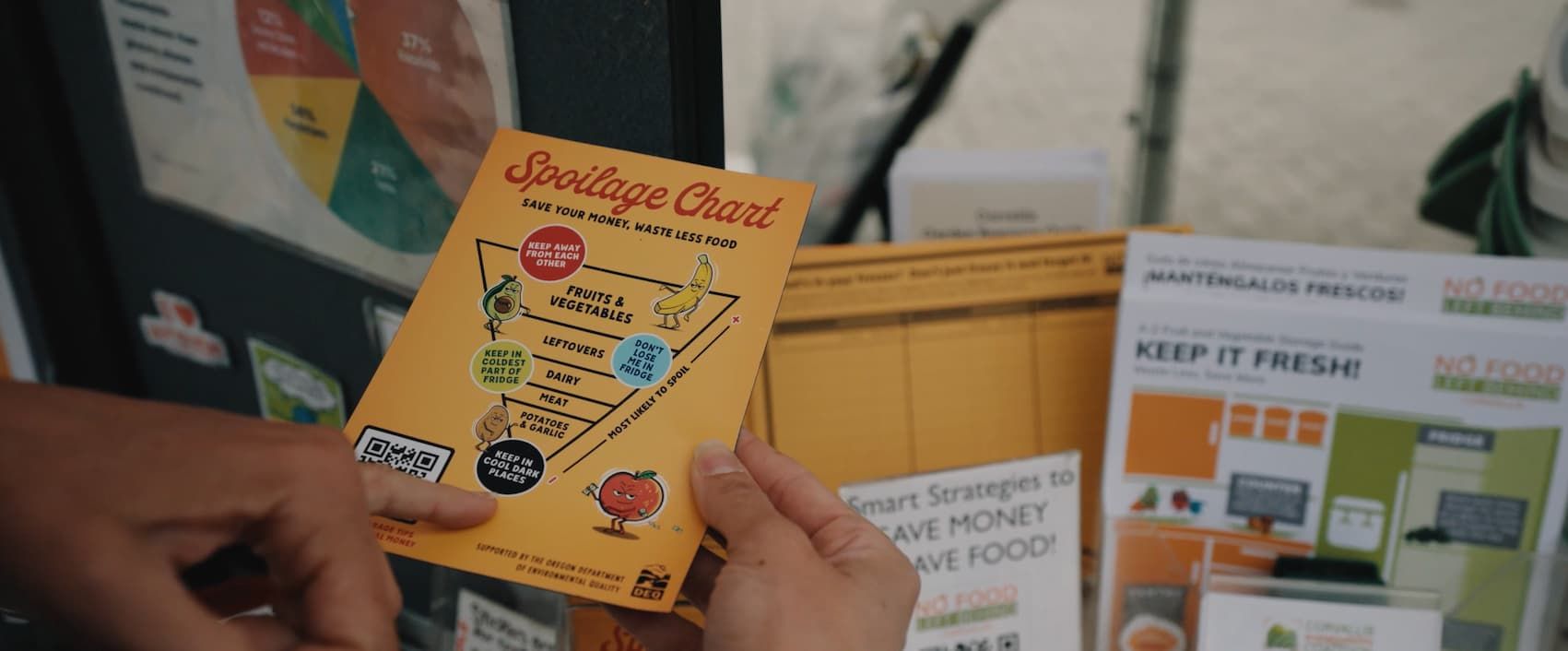
Some are resources Jeanette and No Food Left Behind Corvallis have developed. Others have been adopted from Oregon DEQ and other food waste prevention efforts.
The smart part is that none of it is particularly complicated. One of the simplest ideas is to create an “Eat First” area in the refrigerator. Put the food that needs to be eaten soon in one place where everyone can see it.
That's it.
No new appliance. No complicated system. No app to download. Just put the food you're most likely to lose somewhere you're more likely to notice it.
Jeanette knows the idea works because she uses it herself. And she also knows it isn't perfect. Over the years, she and K'Rene have shared their own food waste mistakes publicly, in their “Kitchen Confessions” blog. Waffles that stayed in the freezer too long. Grapes forgotten in the crisper. Cheese hidden in a drawer. Leftovers that somehow managed to disappear even on an Eat First shelf.
Jeanette, it turns out, wastes food too.
There is something refreshing about hearing that from someone who has spent much of her career trying to prevent it. There is no lecture here. No expectation that someone is going to leave her tent and suddenly become perfect at using every ounce of food they buy.
She just wants to help them get a little better at it.
Back at the Farmers' Market, that's happening one conversation at a time. And the setting makes it hard to ignore what they're talking about. The food surrounding us is beautiful. Someone grew it, planted it, watered it, harvested it, packed it, and transported it. They even woke up early enough to arrange it on a table in downtown Corvallis. Someone else pays for it, puts it into a bag and carries it home.
There is a lot invested in food before any of us ever take the first bite. Jeanette wants to make sure we get there. So they talk about storage.
Some fruits and vegetables belong in the refrigerator. Others do better somewhere else. Some produce can cause other produce nearby to ripen faster. Some foods can be frozen before they spoil. Others can be cooked, preserved or used differently when they're beginning to get past their prime.
The advice changes depending on what's sitting in someone's market bag. But the goal doesn't.
Give the food a little more time. And give the person who bought it a better chance to eat it.
That philosophy runs throughout No Food Left Behind Corvallis.
“I want everyone to know just how easy it is to prevent wasted food at home when we’re mindful, creative and have the right tools”
Plan before you shop. Buy what you'll use. Store food so it lasts. Keep track of what's already in the refrigerator and freezer. Eat what needs to be eaten first. Freeze what you won't get to in time.
Individually, none of these actions feels particularly significant. Together, they begin to change what happens inside a household.
And maybe that's what Jeanette understands better than most. None of it feels particularly revolutionary.
Maybe that's why it works.